

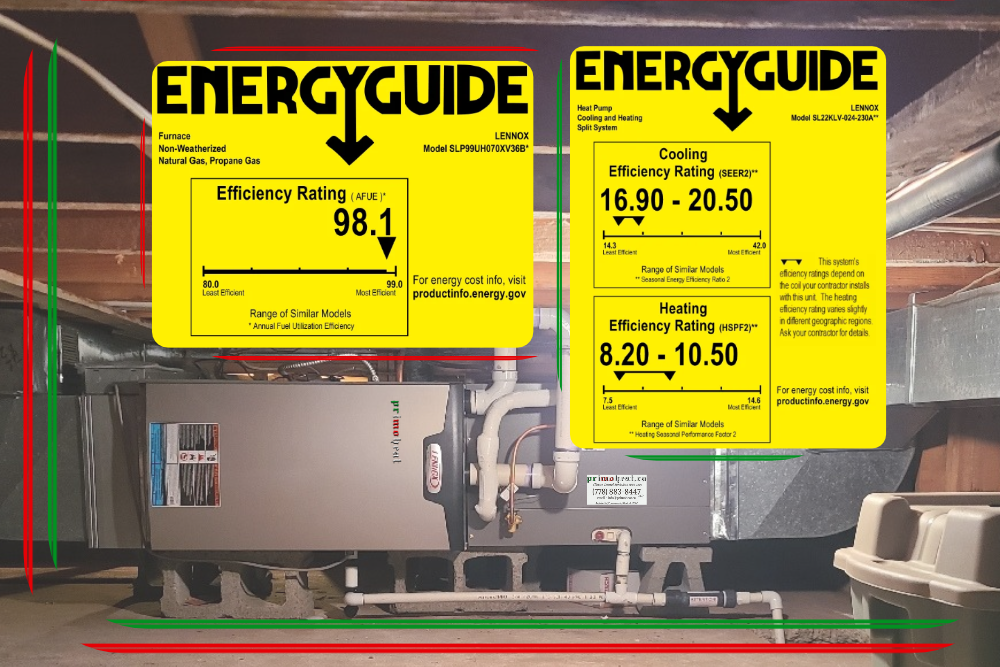
Shopping for a new furnace or heat pump means swimming through a sea of numbers, percentages, and acronyms that seem designed to make your eyes glaze over. At Primo Heat, we think learning how to read an EnerGuide label on heating and cooling equipment shouldn’t require an engineering degree. These labels exist to give you real, standardized information so you can compare equipment fairly.
Learn the differences between single stage and two stage heating systems.
What the EnerGuide Label Is Telling You
The EnerGuide program is administered by Natural Resources Canada and requires manufacturers to test equipment under standardized conditions and display the results. The label is your apples-to-apples comparison tool. It cuts through marketing language and gives you objective numbers across competing models.
One important distinction worth knowing upfront: EnerGuide labelling and ENERGY STAR certification are related but not the same thing. ENERGY STAR is a separate designation for equipment that meets a higher efficiency threshold. An EnerGuide label appears on the equipment regardless; the ENERGY STAR logo only appears if it qualifies.
The Three Efficiency Metrics You’ll Encounter
Different equipment types use different metrics, which is where most of the confusion comes from. Here’s what each one measures:
AFUE: For Furnaces
AFUE (Annual Fuel Utilization Efficiency) tells you how much of the fuel your gas furnace burns actually becomes heat in your home. The rest goes up the flue as exhaust.
- A higher percentage means less wasted fuel
- Standard efficiency furnaces typically fall in the low-to-mid 80s
- The gap between a standard and high-efficiency furnace has a real and measurable impact on your gas bill over a heating season
SEER: For Air Conditioners and Heat Pumps (Cooling Mode)
SEER (Seasonal Energy Efficiency Ratio) measures cooling efficiency across a full season of varied conditions. Higher SEER means less electricity consumed per unit of cooling delivered.
- Minimum efficiency standards in Canada set a floor; anything above that is a bonus
- A higher SEER matters most if you run your cooling system heavily through summer
HSPF: For Heat Pumps (Heating Mode)
HSPF (Heating Seasonal Performance Factor) is the heat pump equivalent of AFUE. It measures how efficiently the system produces heat over a full heating season.
- HSPF becomes especially relevant here because heat pumps are increasingly being used as primary heating sources, not just cooling add-ons
Find out why heat pump costs vary by season.
What the Label Won’t Tell You
This is the part most equipment guides skip, and honestly, it’s the most important section.
The EnerGuide rating reflects the equipment’s potential under standardized test conditions. Your actual results depend on factors the label has no way of measuring:
- Installation quality: A high-efficiency furnace installed incorrectly will underperform a mid-efficiency unit that’s properly set up. The number on the label is a ceiling, not a guarantee.
- Proper sizing: Oversized or undersized equipment runs inefficiently regardless of its rating. Right-sizing matters more than chasing the highest number.
- Home envelope: If your insulation is working against you, the most efficient furnace in the world is fighting uphill.
- Variable speed operation: Certain models feature variable speed motors, which affect real-world comfort and efficiency in ways the headline AFUE number alone doesn’t capture.
How to Actually Use This When You’re Shopping
A few honest principles that will serve you better than just chasing the highest number on the label:
- Compare within equipment types: AFUE to AFUE, SEER to SEER. These metrics don’t translate across categories.
- Think about your usage patterns: If your home is well-insulated and you have a mild heating load, the payback period on a top-tier high-efficiency unit extends further out than you might expect. We’ll tell you that even if it changes what we’d recommend.
- Ask about real-world performance, not just ratings: The gap between what the label says and what a properly installed, properly sized unit actually delivers in your specific home is worth understanding before you buy.
Making Sense of It All
EnerGuide labels are genuinely useful once you know what you’re looking at. Each metric tells part of the story, and installation quality tells the rest. If you’re comparing models and want a straight answer about what those numbers mean for your home in the Fraser Valley, give us a call at 778-883-8447. We’re happy to walk through it with you.