

At Primo Heat, we hear this one a lot: “I installed a heat pump because everyone said it was the efficient choice. So why does my power bill in January look like I’ve been heating the whole neighbourhood?” If that sounds familiar, you’re not dealing with a broken system or a bad decision. You’re dealing with physics, and once you understand why heat pump costs vary by season, the whole picture makes a lot more sense.
Heat Pumps Move Heat, They Don’t Make It
This is the foundation of everything. A heat pump doesn’t generate warmth the way a furnace burns fuel to create it. Instead, it transfers heat from one place to another, pulling heat out of outdoor air in winter and moving it inside, then reversing that process in summer.
The catch? The harder the system has to “reach” to find that temperature difference, the more energy it takes to do the job. Think of it like pushing water uphill. A gentle slope is easy. A steep climb takes real effort.
In mild weather, both directions of that transfer are relatively easy. Extreme temperatures, whether January cold snaps or August heat waves, steepen the slope considerably.
Learn more about how heat pumps work.
Why Winter Is Where You’ll Feel It Most
Summer performance tends to stay fairly consistent across the Fraser Valley season. Winter is where homeowners notice the most variation, and for good reason. When outdoor temperatures drop toward freezing and below, a few things happen at once:
- The temperature gap widens: Your system has to extract usable heat from much colder air, which requires more work for the same indoor result.
- Frost builds on the outdoor coil: Heat pumps periodically reverse direction to clear this frost. During a defrost cycle, the system briefly blows cooler air. This is normal, not a malfunction.
- Backup heat may activate: Many systems include electric resistance heating as a backup for extreme cold. It gets the job done, but it’s significantly more expensive to run than the heat pump itself.
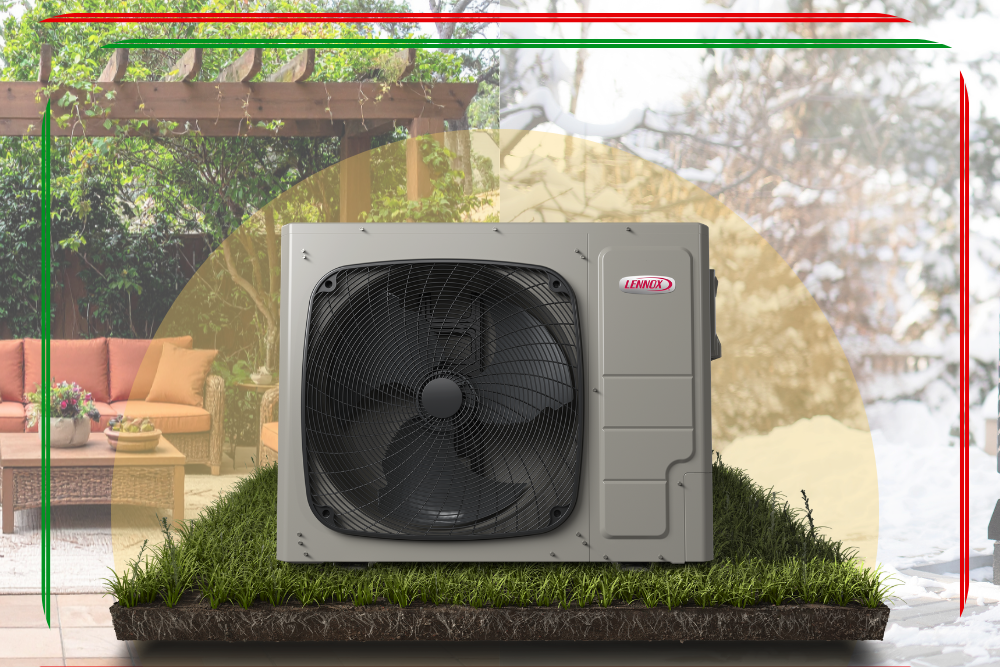
This is exactly why not all heat pumps are built equally for BC winters. We carry models like the Lennox Elite EL18KSLV specifically because they’re designed for cold climate operation, maintaining meaningful efficiency at lower temperatures than standard models can manage.
What SEER2 and HSPF2 Actually Tell You
You’ve probably seen these numbers on equipment spec sheets. They’re worth understanding because they explain something counterintuitive: rated efficiency is always a seasonal average, not a fixed daily output.
SEER2 (Seasonal Energy Efficiency Ratio) measures cooling efficiency across an entire summer of varied conditions. HSPF2 (Heating Seasonal Performance Factor) measures heating efficiency across an entire winter. Neither number tells you what your system does on any given day. A high SEER2 rating means the unit performs well on average across a range of summer conditions, not that it delivers peak performance every single day regardless of temperature.
This matters because it resets expectations. A bill that ticks up in January isn’t evidence your system is failing. It’s evidence that January is genuinely harder on your equipment than September is.
Learn more about SEER2 and HSPF2 ratings.
What’s Normal vs. What Needs Attention
Seasonal variation is real and expected. Actual problems can hide inside that variation if you’re not watching for the right signs.
Normal seasonal behaviour looks like longer run times during cold snaps, periodic defrost cycles (you may see steam or frost clearing from the outdoor unit), and higher energy bills in the coldest weeks compared to fall or spring.
Actual problem signs you should watch out for include:
- The system ices up heavily and repeatedly, not just during a defrost cycle
- Heating feels inadequate when temperatures are well above freezing
- Performance has dropped noticeably compared to the same time last year
- Unusual noises appear during temperature swings
Not sure? Give us a call. We’ll be honest with you about which category you’re in. If what you’re describing is normal seasonal behaviour, we’ll tell you that directly rather than talk you into a service call you don’t need.
Sizing and Selection Change the Equation
One point we take seriously with every installation, a properly sized system shows far less dramatic seasonal variation than one that is over or undersized. An oversized unit short-cycles, satisfying the thermostat quickly but running inefficiently. An undersized unit struggles to keep up in extreme conditions and leans heavily on backup heat.
Our team brings over 60 years of combined experience to system selection. The Fraser Valley’s specific climate factors into every recommendation we make, including those shoulder season stretches, the occasional hard freeze, and the wet cold that feels worse than it looks on a thermometer.
Seasonal Cost Is Physics, Not a Problem to Solve
Heat pump cost varies by season because moving heat becomes genuinely harder as temperatures widen. That’s not a flaw in the technology; it’s how thermodynamics works. The right system, sized correctly for your home and selected with your local climate in mind, manages that variation better than a generic option would.
If your heat pump is behaving in a way that doesn’t sit right with you, or you’re wondering whether your current system is the right fit for a Fraser Valley winter, give us a call at 778-883-8447. We’d rather help you understand what you’re working with than leave you second-guessing a system that might be doing exactly what it should.