

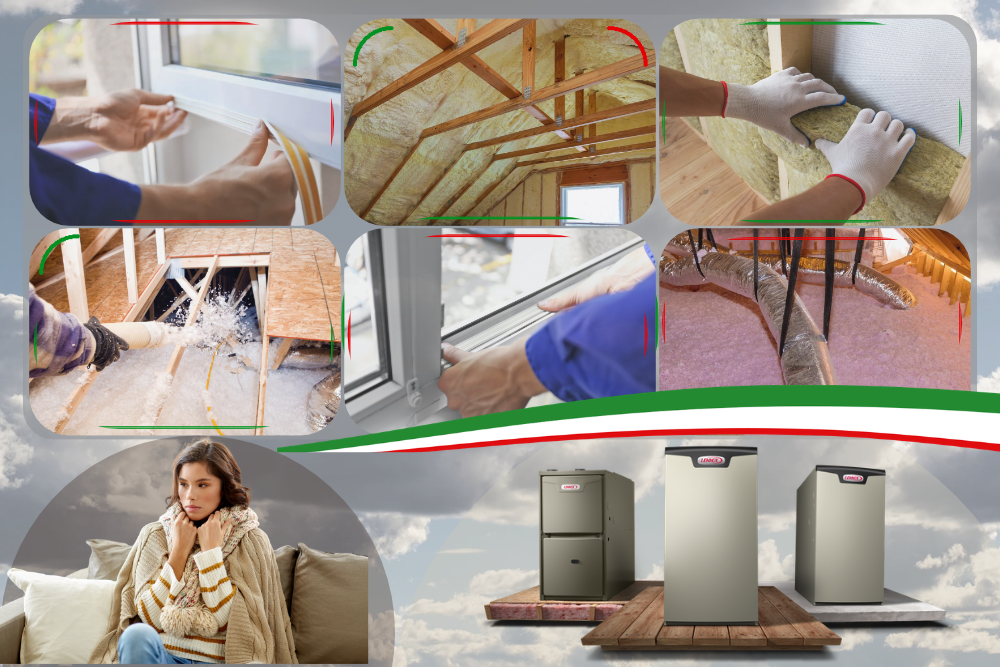
At Primo Heat, we field a lot of calls from homeowners who are convinced their gas furnace is dying. The thermostat is cranked, the system is running constantly, and they’re still shuffling around in wool socks wondering where all the heat went. Sometimes the furnace really is the problem, but more often than not, we find ourselves having a different conversation entirely. How poor insulation affects your heating system’s performance is one of the most misunderstood issues in home comfort, and getting it wrong means spending money in the wrong place.
Your Heating System Is Fighting Physics
When your home isn’t properly insulated, heat escapes continuously through the attic, walls, floors, and any gap that connects conditioned air to the outdoors. Your furnace or heat pump doesn’t know why the temperature keeps dropping. It just knows it hasn’t hit the setpoint yet, so it keeps running.
Think of it like trying to fill a bathtub with the drain open. The equipment isn’t broken; it’s just outmatched.
This constant demand puts real strain on your system:
- Components cycle more frequently than they’re designed to
- Heat exchangers, motors, and controls accumulate wear faster than normal
- Equipment that should last 15 to 20 years starts showing problems much sooner
- Energy bills climb steadily with no obvious explanation
When Symptoms Point the Wrong Direction
The tricky part is that poor insulation produces symptoms that look exactly like HVAC issues. We’re not surprised when homeowners assume the system is at fault because the signs are genuinely misleading.
Watch for these patterns:
- Uneven temperatures between rooms: One bedroom is comfortable, another feels like a walk-in cooler. Insulation deficiencies rarely affect a home uniformly.
- Cold walls or floors: Exterior walls and floors over unheated spaces should feel roughly room temperature. If they don’t, heat is leaving through the structure.
- Furnace runs constantly but the house stays cold: The system is performing; it’s the building envelope that isn’t.
- Ice dams on the roof in winter: A classic sign that warm air is escaping through a poorly insulated attic.
We’ll tell you straight when we think the real issue lives outside our scope of work. That’s not us passing the buck. That’s us making sure you don’t spend money on a new furnace when what your home actually needs is an insulation contractor.
Find out why heat pump costs vary by season.
Why a High-Efficiency Furnace Can’t Fix an Insulation Problem
This is worth saying clearly: upgrading to a high-efficiency furnace in a poorly insulated home won’t solve your comfort or cost problems. It will just give you a more expensive piece of equipment running just as hard as the old one.
Modern two-stage and variable-speed systems, the kind we install, are designed to modulate output and run at lower, steadier capacities. That’s where their efficiency and comfort advantages actually come from. But that only works when the building envelope is holding heat properly. In a leaky home, these systems run at full capacity constantly, and you lose most of what makes them worth the investment.
The Sizing Problem Nobody Talks About
There’s another consequence worth understanding: oversizing. When a contractor sizes a furnace for a poorly insulated home, they’re essentially baking in compensation for all that heat loss. The system gets specified larger than it needs to be.
Fix the insulation later, and now you’ve got an oversized furnace that short-cycles, firing up, hitting temperature quickly, shutting off, and repeating that cycle far more often than it should. Short-cycling is hard on equipment and produces uneven, less comfortable heat.
Getting the sequence right matters:
- Address insulation deficiencies first
- Right-size the heating system based on the home’s actual, improved thermal performance
- Commission and optimize the system for the conditions it will actually operate in
That’s how you get a system that runs efficiently, lasts longer, and keeps the house comfortable without working itself to death.
Find out how variable speed motors improve home comfort.
What We Can Actually Tell You
When we come out to assess a heating system that’s struggling, part of what we’re doing is reading the evidence. A furnace that’s running far more than it should, in a home that still can’t stay warm, tells a story. We can identify the signs that point toward insulation as the root cause and give you an honest picture of where to direct your energy and your budget.
We’re not insulation contractors, and we won’t pretend to be. But we know enough about how heating systems behave under thermal load to tell you when fixing the furnace would be the wrong first move.
If your heating bills keep climbing and your house still isn’t comfortable, give us a call at 778-883-8447. We’ll take an honest look at what’s actually going on, and if the answer is “talk to an insulation contractor before you do anything with your HVAC system,” that’s exactly what we’ll tell you.